Showing posts with label Art and Science. Show all posts

Monday, 31 May 2010

Travel, Art, Science and "Rock in the Landscape"


One of the great perks of life as a scientist is the travel opportunities (it is hardly a coincidence that so much is known about Hawaiian fruit flies and so little about Siberian ones...if, indeed, Siberia has fruit flies)....

Facetiousness aside, I have been very lucky in that my scientific career has allowed me to either visit or work in nineteen countries over the past decade, spread across four continents. Some of that was because I began by studying jellyfish, which are not only pelagic, but extraordinarily difficult to keep in captivity (only about a dozen species have ever been kept in captivity for a prolonged period- perhaps more now, but not many more). There is something really useful about seeing living organisms in their natural habitats, and seeing as many habitats as possible that, even yet, no amount of reading or watching videos can replace. It is not coincidental that many of the biggest biological or, at least, zoological and botanical, theories have been devised after extensive travel- Darwin’s trips on The Beagle are the obvious examples, but I am also thinking of the work of Walter Henry Bates in the Amazon. Then, of course, there were the voyages of Alfred Russell Wallace leading to his independent discovery of evolution and to his finding “The Wallace Line*”. Probably every biogeographer or wandering zoologist since Wallace has dreamed of finding their own “line”.

As a scientist, travel was absolutely essential to my work for many years- allowing me to collect samples, conduct measurements and take research photographs in the wild. I also benefitted enormously from having seen specific behaviours occurring in the natural world.

On a human level, I was- and still am- always amazed that different places have such strong and unique atmospheres, especially cities. For ages, I have wanted to capture on film the mood of several markedly different places and to share something of these experiences. However, as this is an artistic, rather than a scientific project, so it has long been on the back- burner. Finally, over the past year, I have been able to work on it in earnest. The result is my first fine art (photography) book: “Rock in the Landscape”, which was released today.

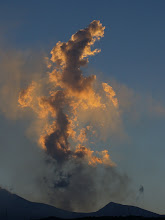
The book is a series of landscape (and a few macro) photographs, showcasing rock in various environments- from volcanoes in Korea and Sicily, to the Italian Alps near Turin, Hungarian Hills, English Meadows, the Ramparts of Jerusalem and the crumbling walls of Armageddon. You can see the book in more detailand/or buy online [HERE].


Image (c) Victoria Neblik, 2010. Extracted from "Rock in the Landscape" [LINK HERE]

If you click on the picture below, you can flick through 43 (of the 88) pages in the book-

(*The Wallace Line divides Borneo from “Celebes” (aka Sulawesi) and Bali from its eastern neighbour, Lombok; the wildlife one side of the line is dramatically different from that on the other- Wikipedia has a longer explanation of The Wallace Line)

Saturday, 3 April 2010

Art is Art and Science is Science and never the twain shalll meet?

In 1959 Baron Charles Percy Snow wrote of the “Two cultures” of intellectuals- artists and scientists. This is one of the better sections-

A good many times I have been present at gatherings of people who, by the standards of the traditional culture, are thought highly educated and who have with considerable gusto been expressing their incredulity at the illiteracy of scientists. Once or twice I have been provoked and have asked the company how many of them could describe the Second Law of Thermodynamics, the law of entropy. The response was cold: it was also negative. Yet I was asking something which is about the scientific equivalent of: 'Have you read a work of Shakespeare's?'

I now believe that if I had asked an even simpler question — such as, What do you mean by mass, or acceleration, which is the scientific equivalent of saying, 'Can you read?' — not more than one in ten of the highly educated would have felt that I was speaking the same language. So the great edifice of modern physics goes up, and the majority of the cleverest people in the western world have about as much insight into it as their Neolithic ancestors would have had.


As an idea, “the two cultures” has both outgrown and outlived its inventor ( is an idea “invented? discovered?) and it gets revisited regularly- for example last year in “Seed” magazine-
http://seedmagazine.com/content/article/are_we_beyond_the_two_cultures/

It is an idea I think about a lot, particularly now, that I divide my time between arts and sciences: writing- mostly about science- but about other topics, too, such as Bushido, rock music and Zen Buddhism (not at the same time...) under different aliases. Over the last couple of weeks, I have been- variously- reading scientific papers about dung beetles and turtles, working on a popular science book and completing my latest collection of limited-edition art-prints: a series of botanical images called “Spring Florals”. It is an odd schedule and, frankly, fairly punishing at the moment, for all it is good fun. Far weirder, however, is the reaction of other people to this mixed-bag of projects.


On the one hand, interdisciplinary projects are very fashionable in science-grant-awarding circles, and, likewise, being a “polymath” (for want of a better word) is de rigueur in internet-land: how else can one explain the model Katie Price (Jordan) being listed by Wikipedia as an “actress, author, business woman, media personality, philanthropist, glamour model, producer, singer, song-writer and television personality”?

John Brockman wrote nearly twenty years ago about the “third culture” (an idea first mooted by CP Snow) of people intermediate between arts and sciences forming a sort of “ideas/ideology bridge” (my words, not his) between the two camps.
http://www.edge.org/3rd_culture/
It is certainly easy to think of people in public life who would fit in this category. Prof. Steve Jones, Prof. Richard Dawkins, Prof. Brian Cox...

On the other, hand, this attitude filters very poorly into real life. For example, I have an “arty” friend who has enormous trouble taking my photography seriously on the grounds that I trained as a scientist and therefore, have nothing to bring to the world of art. Equally, I have a science-trained friend, who considers my arty pursuits to be not worthy of my time: beneath a scientist almost. Equally, numerous universities (at this point, I will refrain from naming and shaming) pay lip service to the importance of science communication and this “third culture” but stubbornly refuse to pay for it or even to consider what it might involve, beyond employing a few PR staff and doing press releases.

In the fifty years since Baron Snow’s speech, we have put man on the moon, cloned sheep , discovered quarks and pulsars but we are still having trouble with the concept of a “third culture”.


- (c) V Neblik, 2010. All rights reserved.