Sunday, 5 June 2011

E. coli, Polar Bears, Sanderlings and Kenya- Science News round-up.


Female Polar Bear (photographed beside Whale Carcass at the Arctic National Wildlife Refuge, Alaska, USA by Alan D. Wilson) (for image source and (creative commons) license details, click [HERE] )

Recent science news has been dominated by the E. coli outbreak in Germany and its casualties in various parts of Europe. The latest news on this, according to both Sky news and The International Herald Tribune, is that the source of the outbreak was or was associated with sprouted beans from a German organic farm-

http://www.nytimes.com/aponline/2011/06/05/world/europe/AP-EU-Contaminated-Vegetables-Europe.html?_r=1&ref=global-home

Organic farming is widely considered more healthy than standard farming by the general public, however, it does have its own problems; so the idea that organic farming could be associated with bacterial problems is not as surprising as the Agriculture Minister seems to imply in this article. Known potential problems with organic food include a higher risk of toxic and carcinogen-producing- moulds growing on the produce than with conventionally farmed vegetables.

One of the more beautiful stories this week is the creation of an ice bear sculpture in Sydney to highlight climate change-
http://tinyurl.com/5wzlgqo

Sticking with the Polar bear theme , the first Quote-of-the-week this week is taken from the Kenya Diary the British Army Intelligence Officer, voracious Game Hunter, Ornithologist and Diarist Richard Meinertzhagen-

“I sat by the lake most of the day, watching the hippo, duck and flamingo. There are still a few northern waders about, notably greenshank, marsh sandpiper and little stint. One single sanderling attracted my attention for being so far inland. To consort with hippo in winter and polar bears in summer must be a delightful experience and yet that is what this small bird must do every year.”

-Richard Meinertzhagen, 21st Feb 1903, Lake Nakuru, Kenya.(Kenya Diary, 1902-06 (1902-1906))


Sanderling, picture by Pierre Camateros, (for image source and (creative commons) license, click [HERE] )

The Sanderling, which has been described, variously, by three biological names- Calidris alba, Crocethia alba and Erolia alba – is a small wading bird with a famously long migratory route. It is unusual because it has also been known to form polyandrous (one female and two male) pairings in the mating season, with one female pairing off with two males, instead of the more usual monogamous pairs of one male and one female.
(You can find more details about it
[HERE]).

Meinertzhagen’s diaries are famously blood-soaked accountsof his army tours and hunting exploits in East Africa and reading them, as I have been doing this weekend, it is hard to find more than a few lines of wildlife description that does not end in the creature in question being shot. None-the-less, there are moments of beauty, not to mention weirdness, such as his accounts of dealings with cannibalistic tribesmen and his taking measurements of the speeds of different animals in the wild.

The second, and final quote-of-the-week, then is his comments on viewing a lunar rainbow -

“I went to the top of Silie Hill after supper. It was full moon at the time with a fairly heavy mist. I witnessed for the first time a lunar rainbow, which was very beautiful, though somewhat weird”

- Richard Meinertzhagen, 12th November 1905. Silie Hill, Nandi, Kenya, Kenya Diary, 1902-06 (1902-1906)


Image of lunar rainbow (moonbow) over Victoria Falls (image by Calvin Bradshaw – for image source and license details, click [HERE]).


Monday, 23 May 2011

Mars, Water on The Moon, Earthquakes and Zebras


Mars: Picture by NASA.

Welcome (back) to Weirdbeautiful.

Today's scientific links are on Earthquakes and Distant planets, starting with the associated press story that "Millions of people in Europe, the Middle East and Asia are at risk from deadly tremors which can strike out of the blue in unmapped earthquake zones".

http://uk.news.yahoo.com/millions-risk-earthquakes-175919138.html

Meanwhile, one of the weirder stories in the past few weeks has been the New Scientist competition to win a part of Mars rock. The magazine wants competitors to suggest the first words that should be spoken by the first man landing on Mars: the next giant leap for mankind-
https://www.newscientist.com/marscompetition/login

Sticking with the theme of astronomy, the press association has also published a story saying that "water may be as plentiful in the moon's interior as the Earth's". This statement is based upon a study of lunar rocks that were first brought to Earth in 1972, by the last manned mission to the moon, Apollo 17. Trapped water was found in tiny volcanic glass beads within the rock samples and it has now been suggested that "there could be 100 times more water in the lunar mantle, the thick rock layer beneath the surface crust, than was previously thought". The full article is online here- http://uk.news.yahoo.com/moon-could-plenty-water-183040048.html


Grey's Zebra Stallion: image by "Rainbirder" (this image has a creative commons 2.0 license- for details, click [here])

Good news was recently announced by Edinburgh Zoo, where two Grevy's Zebras have had foals. Grevy's Zebras are endangered in the wild- their population has now fallen to between 2,000 and 2,500 animals (less than 20% of what it was 30 years ago).
http://news.uk.msn.com/environment/articles.aspx?cp-documentid=157680732

Finally, Xixiakou Wildlife Zoo in Weihai, Sahndong Province, eastern China has released a picture of a dog nursing liger cubs after they were abandonned by their mother. Ligers: the offspring of a male lion and a female tiger: are hybrid animals with interesting biology- not least, their tendency to grow much larger than either lions or tigers. You can find more on ligers [HERE]

and the zoo story (worth the detour for the picture alone)is online here-
http://www.stumbleupon.com/su/28TtWg/www.azcentral.com/offbeat/articles/2011/05/24/20110524china-dog-nurses-tigers.html

Sunday, 22 May 2011

Links of the day- Panda Cubs and Komodo Dragons

Welcome (back) to Weirdbeautiful.

First link of the day today is this humorous article about the joys of keeping a Komodo dragon as a pet-
http://7reasons.org/2010/09/24/7-reasons-a-komodo-dragon-is-the-ideal-pet

Weird link-of-the-day is this stunning picture of camel-thorn trees in Namibia, which, contrary to appearances, is a photograph, not a painting-
http://www.juxtapoz.com/Current/this-is-a-photograph-not-a-painting

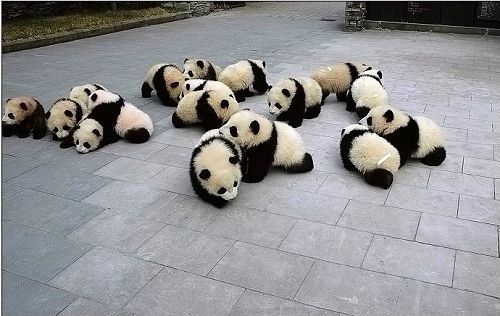
The other links-of-the day are to baby giant panda pictures for no reason other than whim- that and that baby pandas have been in the news recently-

for Baby Panda Picture 1, Click-[HERE]

for Baby Panda Picture 2, Click- [HERE]

for Baby Panda Picture 3, Click- [HERE]

finally, Baby Panda Picture 4 is of a 30-minute old cub from the Wolong Breeding centre- click [HERE]

Thursday, 19 May 2011

Quote of the Day: Conservation- the Dalai Lama

Pansies- Viola sp.


Welcome (back) to Weirdbeautiful. Quote-of-the-day today is on the theme of conservation-

"Ultimately, the decision to save the environment must come from the human heart. The key point is a call for a genuine sense of universal responsibility that is based on love, compassion and clear awareness"

- The Dalai Lama, Tenzin Gyatso (in "Humanity and Ecology").


The first Link-of-the-day today is to this graphic on the "Information is Beautiful" science-in-society website. The graphic- "Mountains out of molehills" shows how the relative coverage of scientific events, disease outbreaks etc. is not very closely correlated to the severity of the incident- http://www.informationisbeautiful.net/play/mountains-out-of-molehills/

Today's second, vaguely scientific link is this piece in The Guardian giving advice on spotting the space ship "Endeavour" in the skies over Britain in late May-
http://www.guardian.co.uk/science/2011/may/18/spacewatch-endeavour-shuttle

Sunday, 15 May 2011

Echidna

Hi. Welcome (back) to Weirdbeautiful
Link of the day today is an article about an echidna being treated at Taronga Zoo (Sydney) for injuries he sustained when hit by a car-

http://www.smh.com.au/news/national/cec-the-echidna-bubbles-over/2006/07/25/1153746845587.html

Monday, 9 May 2011

Quote of the Day: Snails


"One [practitioner of science] is the educated man who still has a controlled sense of wonder before the universal mystery, whether it hides in a snail's eye or within the light that impinges on that delicate organ."
- Loren Eiseley (3rd September 1907– 9th July 1977),
American Anthropologist and Science Writer.

Women in science

Welcome (back) to Weirdbeautiful!

Today's links are about women in science.
The first is to the web comic xkcd, which partly inspired the other two links-
http://xkcd.com/896/
(thanks to Joe W. for that link)

The second is to the wikipedia entries for Lise Mietner and
Emmy Noether

It is said that most mathematicians make all their truly important contributions prior to the age of around thirty. Emmy Noether is a nice example of a mathematician who bucks this trend. The German mathematician and theoretical physicist Hermann Weyl described Noether's life's work as occurring in three "epochs"- the last of which, ran from 1927, when she was 45, until her death (from complications of surgery)in 1935.